
A lifelong academic organisation
What is a student fraternity?
A student fraternity is a lifelong academic organisation made up of students and of those who have completed their studies, the philisters. It is more than a shared way of life: a fraternity has an ideology of its own and firm principles that took shape over several centuries.

- Lettonia, the oldest Latvian student fraternity, founded
- 1870
- the Presidium Convent founded at the University of Latvia
- 1919
- student fraternities in P!K!
- 20
01
Four basic principles
Latvian fraternities rest on four principles that took shape in student organisations over the centuries: brotherhood, honour, seniority and upbringing. All four are equally important and bound up with one another.
Brotherhood
Its aim is mutual understanding and growing together towards a common ideal. The words used among fraternity members, fraternitas (brotherhood) and commilito (comrade in arms), show how old the idea is.
Honour
A society that keeps a code of honour settles matters of honour among its members as among equals. The fraternities have kept this principle and hold honour in high regard; the comment of honour binds every member.
Seniority
Respect and friendship between the older and the younger. Seniority is set by how long a member has belonged to the fraternity, not by his age. In matters of honour it has no bearing: there all have equal rights.
Upbringing
A fraternity instils in its members a deep sense of duty, character and bearing, and prepares capable people for the state and for society. It fosters an interest in science and the arts, and the growth of mind and body.
02
What sets a fraternity apart
Five traits that set a fraternity apart from other student organisations.
- For life
- A fraternity is an organisation for life: those who belong to it remain loyal to one another to the end. That is why a person can belong to only one fraternity.
- By selection
- One cannot simply join. New members are admitted with the consent of the majority and in small numbers, so that the spirit of the fraternity and friendship can be better instilled. Those admitted together form a coetus.
- Order
- A fraternity’s activity is governed by comments, its written laws, and by its unwritten customs. Its life runs within the comments and is determined by the decisions of the convent.
- A life kept within
- The life of a fraternity is internal: what happens there is not spoken of in society at large. The fraternities themselves are no secret; their names, colours and addresses are on this site.
- No politics in the convent
- Political and religious questions are not debated in the convent; membership of a party or a religious group is each member’s private affair. At the same time the fraternities take a firmly national stance.
03
The path through a fraternity
The ranks of membership came to student societies from the craft guilds. Each rank has a name of its own.
Fox
A newly admitted member; some fraternities have their own word for him. From admission he is an equal member of the society, who still has to acquire the upbringing of a fraternity member in the way its laws prescribe.
Colour-bearer
A member entitled to wear the colours of his fraternity: the colour sash and the cap. Among themselves the members are commilitones, comrades in arms.
Philister
A member who has completed his studies. Philisters stay with their fraternity for life and come together in its philisters’ society.
Getting to know a fraternity
At the start of every semester the fraternities hold guest evenings, to which anyone interested is welcome. The dates are on the fraternities’ websites and social media; the links are on each fraternity’s page. Sororities are united by their own Presidium Convent, S!P!K!.
04
Colours and symbols
Every fraternity has insignia of its own. They are not ornament: the colours, the cap, the monogram and the coat of arms show which fraternity a person belongs to.
- Colours
- Three colours, read from top to bottom. They are worn on the colour sash and the cap, and they are on the fraternity’s flag.
- Cap
- A cap in the fraternity’s colours. Its top carries an embroidered ornament, the cap star, different for every fraternity.
- Monogram
- The fraternity’s mark, the Zirkel: its letters woven into one sign that ends in an exclamation mark.
- Coat of arms
- One of the fraternity’s most important regalia. It usually shows the colours, the monogram and rapiers.
- Motto
- A short sentence, often in Latin, that says what the fraternity stands for.
Selonija
- Draugam Tēvijai
- Virtute et Fide
 Coat of arms
 Monogram
 Cap
 Cap star
05
Life in a fraternity
A fraternity brings together fellow students and specialists from many fields who have already graduated. Together they learn, train and celebrate.
Literary evenings
Papers and talks on science, society and culture, often followed by a debate.
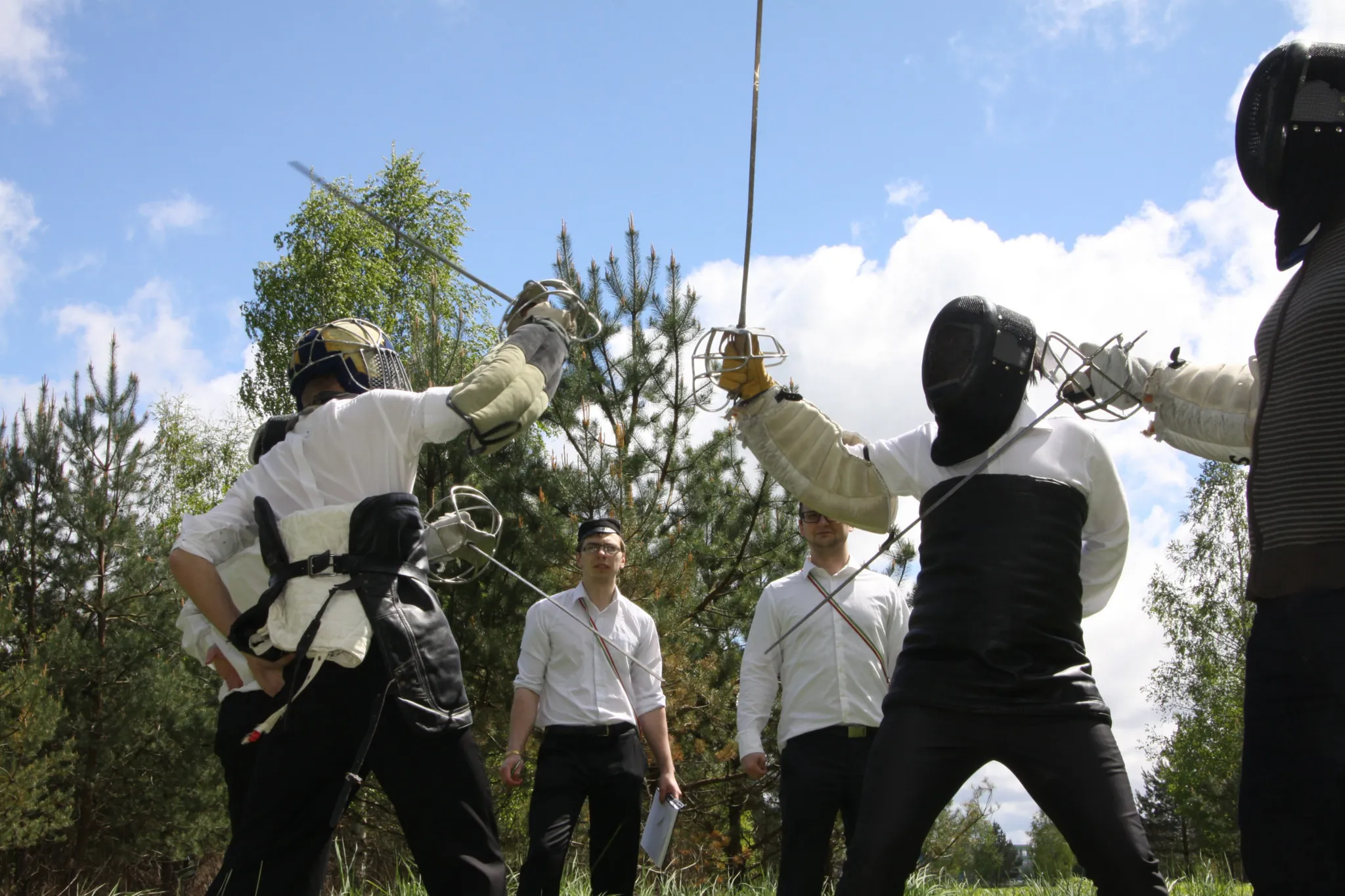
Fencing
Academic fencing is an old student tradition that the fraternities keep up in regular practice.
Song
Fraternity men sing together. In 1925 they founded the P!K! Men’s Choir, in which only fraternity members sing.
Commerses
A commers is a fraternity’s festive celebration. At the Baltic Nations’ Commers the fraternities of Latvia, Estonia and the Baltic Germans meet.
Sport
Training and competitions together, from basketball and football to the fraternities’ sports games.
18 November
On the morning of the national day the fraternities walk in silence from the University of Latvia to the Brethren Cemetery in Riga, where those who fell in Latvia’s War of Independence lie. P!K! has organised the procession since 1992.
06
Frequently asked questions
Are fraternities secret societies?
No. Fraternities are openly known academic organisations, and the Presidium Convent is an officially registered association. What is internal is a fraternity’s own life: it is not spoken of outside the fraternity.
Are fraternities political?
No. Fraternities are non-political academic organisations of a conservative and patriotic outlook. Membership of a party is each member’s private affair, but a fraternity member may not belong to organisations whose aims run counter to the principles of the fraternities.
Can one belong to more than one fraternity?
No. One belongs to a fraternity for life, and that loyalty is not shared with another.
What happens after graduation?
The member becomes a philister and stays with his fraternity. That is why students in a fraternity meet people of different generations and professions every day.
Are there fraternities for women?
Yes. The sororities are united by their own Presidium Convent, S!P!K!; more about them is at spk.lv.
What does the Presidium Convent do?
P!K! unites Latvia’s student fraternities: it adopts decisions that bind them, settles disputes and guides their common life. Each fraternity has one vote, and a different fraternity presides every semester.
07
Glossary
- Buršs
- A member of a student fraternity. The word comes from the bursa, the students’ hall of the medieval university.
- Konvents
- The body of a fraternity’s members and its meeting; also its quarters. In English, the convent.
- Komāns
- The body of rules of a fraternity’s internal and external life, the comment. Relations between fraternities are governed by the Comment of the United Fraternities (A!K!K!).
- Ūzuss
- An unwritten law, a custom.
- Coetus
- The group of new members admitted together.
- Komeršs
- A festive celebration of a student fraternity, the commers.
- Kartelis
- An agreement of recognition and friendship between two fraternities, the cartel.
- Zemes tēvs
- The Landesvater, a ceremony in which members profess their faith in their principles, nation, fatherland and fraternity.
- Honoritāte
- A sense of honour, the quality without which a fraternity cannot exist.
The complete text
The text this page is drawn from, unabridged.
Read the complete text
A student fraternity is a lifelong academic organisation made up of students and of those who have completed their studies, the philisters. The fraternity did not come about in a short time; it took shape, and arrived at its present form of fellowship, over several centuries. A fraternity is not a student society held together only by a certain way of life. It carries a definite ideology and firm principles that may not be broken.
Dr. iur. V. Sinaiskis of Fraternitas Arctica sees four basic principles at the foundation of a fraternity:
The idea of brotherhood, whose aim is mutual understanding and growing together towards a common ideal. The terms used among fraternity members, fraternitas (brotherhood) and commilito (comrade in arms), show how old this idea is.
The principle of seniority, which rests on respect and friendship between the older and the younger and binds both in the discipline and traditions of a family. Seniority in a fraternity is set by how long a member has belonged to the organisation, not by his age. The younger always defers to the older, on the basis of mutual respect. This holds in internal and in external life alike. In internal life the younger defers to the older both by the number of semesters and by the rights of office. Among the members of a fraternity this principle has no exceptions. These are rights that run through the structure of the fraternity from the oldest semester to the youngest and carry on from semester to semester. The only exception is matters of honour. There the principle of seniority has no bearing, and in settling them all members of the fraternity have equal rights, whatever their number of semesters.
The code of honour, which in its historical sense means that a society which keeps such a code settles matters of honour among its members as among equals. Students have formed such societies ever since they gained academic freedom. History shows that at certain times these rights were guaranteed to students by the ruler, by the power of the state. The fraternities have kept this principle and hold the idea of honour in high regard. Any member of the society who endangers this principle or fails to observe it is punished by the other members within the laws of the society. The comment of honour binds all fraternity members.
Ritus (order). The aim of this principle is to order the conduct of the fraternities and their members at certain internal occasions. The rituals have clear ideal purposes, and each has its meaning. The Landesvater (Zemes tēvs), for example, is the fraternity members’ profession of faith in their principles, their nation, their fatherland and their fraternity.
All four principles are equally important and are bound up with one another.
For a fraternity to function, that is, to bring its principles to life in the forms of its social life, the society makes high demands of its members. Meeting these demands is at times not only hard; it also takes much moral strength, self-formation and self-control.
At the root of a fraternity’s work is honour, a sense of honour that the fraternities have cultivated and instil in their members. Without this quality a fraternity cannot exist. In the fraternities, which grew out of the medieval “nations”, national consciousness and self-respect hold an important place. The sense of honour is closely tied to love of the fatherland and to the idea of freedom. Only in a society where the rights of every member rest on democratic principles can constructive ideas arise and decisions be taken that benefit each member and the society as a whole. In such a society real order, upheld by all its members, can prevail.
The structure and working of a fraternity are a model of true democracy, and it does not restrict the individuality or the freedom of spirit of its members. A fraternity is a disciplined organisation whose activity is governed by comments (laws) and usus (unwritten laws). Nothing in the life of a fraternity happens by chance, for it runs within the comments and is determined by the decisions of the convent. Discipline forms a conscientious person who is used to controlling his conduct; it builds character and bearing. The discipline of the convent requires that the tasks set by the society be carried out first, and their necessity questioned only afterwards.
The traditions of the fraternities lay down that the life of a fraternity is strictly internal. It does not show outwardly, and what happens there is not spoken of in society at large.
A fraternity is an organisation for life. Those who belong to it remain loyal to one another to the grave. For that reason the fraternities do not allow a member to share this loyalty with another fraternity, that is, to belong to more than one. A fraternity is an organisation for life in a deeper sense as well. It may interrupt its activity, or even end it, but its members cannot close it, because the comments make no provision for that. When active life has ended, a fraternity becomes a society of traditions, whose existence ends when its last member passes away. So as not to divide the society and to keep it of one mind, political and religious questions are not debated in the convent. Membership of an organisation of another kind, of a political party or of a religious group is a member’s private affair. A fraternity member may not, however, belong to organisations and groups whose aims run counter to the principles and aims of the fraternities. A fraternity is an organisation with a firmly stated national and anti-Marxist stance.
Members are chosen by a principle of selection. One cannot simply join; new members are admitted with the consent of the majority of the society. So that the spirit of the fraternity and friendship can be better instilled in the newly admitted, new members are taken in small numbers. Such small groups of the newly admitted form what are called coetus. The coetus in turn make up the fraternity as families make up a state. After admission the newcomer is an equal member of the society, who has to acquire the upbringing of a fraternity member in the way the laws of the fraternities prescribe.
The fraternities instil in their members a deep sense of duty and the courage to defend their nation, their state and society, every member of their fraternity, themselves and the truth, if need be with weapon in hand.
Following the ideals of the fraternities in personal life and in the life of the organisation is what forms the fraternity spirit. It has grown up together with students and the university and will never lose the values it has gathered over the centuries. Nor will a person who follows these principles lose his worth.
Sources
Prezidiju Konvents. Kas ir studentu korporācijas?
The complete text at the foot of this page; the explanations of the principles, the traits and most of the rest are taken from it.
Lettgallia. Vēl par studentu korporācijām. (opens in a new tab)
The four principles (brotherhood, honour, seniority, upbringing) as Lettgallia names them.
Fraternitas Lettica. Korporācijas mērķi. (opens in a new tab)
On upbringing; likewise the aims of P!K! on this site.
Latvijas Universitāte. Korporācijas un akadēmiskās vienības. (opens in a new tab)
On guest evenings, lifelong membership and sororities.
On the non-political character of the fraternities and on commerses.
On the procession of 18 November.
Tēzaurs.lv. Latviešu valodas skaidrojošā vārdnīca. (opens in a new tab)
Definitions of “buršs”, “krāsnesis”, “filistrs”, “konvents”, “komāns” and “komeršs”.
On coats of arms and their characteristic elements.
Studenšu Prezidiju Konvents (S!P!K!). (opens in a new tab)
On the union of sororities.