

The fraternity Fraternitas Academica was founded in Riga on 4 February 1925 to gather students around it for the cultivation of academic life, to develop in them a sense of honour and an awareness of duty, to practise temperance, to further the growth of learning, literature, the arts and sport, and to support the members of the fraternity morally and materially during their studies and afterwards, so bringing up able and strong citizens who could take an active part in the cultural and public life of the Latvian state.
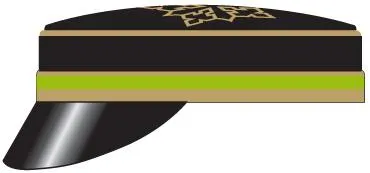
The beginnings of Fraternitas Academica are to be found in the Academic Scout Club (A!S!K!), founded in 1924 to unite students who were scouts and to cultivate spiritual values in the spirit of tradition. The club was confirmed as an autonomous unit within the Central Organisation of Latvian Scouts. The emblem of the A!S!K! showed a lozenge-shaped lily in white enamel with a green border; it has been kept on the crown of the fraternity’s cap, where it takes the form of a five-pointed star.
The fraternity’s original name was Fraternitas Academica, but because of certain objections, and to avoid possible confusion with a German student fraternity of a similar name founded in Tartu, it was changed in 1927 to Fraternitas Academica Latviensis. On 8 February 1933 the Council of the University of Latvia confirmed the fraternity’s original name.
When the new society was registered at the University of Latvia, its founders were 22 students of various faculties of the University: 17 members of the Academic Scout Club, which by then had ceased to exist, and 5 students of the University’s Faculty of Theology.
As most of the fraternity men of the former A!S!K! were members of Lettonia, their suggestion to vouch for the comment with Lettonia was accepted, and in November 1925, in the second semester of its work, the founders, together with the newly admitted first coetus, vouched for the Comment of the United Fraternities (A!K!K!) with the fraternity Lettonia.
The next 4 semesters were full of effort, in which the foundations of the new society were made firm, its internal life was shaped and new members were admitted.
On 8 November 1927 Fraternitas Academica was admitted to the Presidium Convent (P!K!) as a fraternity with full rights. In March 1928 the Philisters’ Society (F!B!) was founded. Its founders included members of the active convent who had graduated as well as honorary philisters admitted in the first years.
On 15 April 1929 the F!B! was admitted to the Union of Philisters’ Societies (F!B!S!), in which it worked until the F!B!S! was dissolved in 1940.
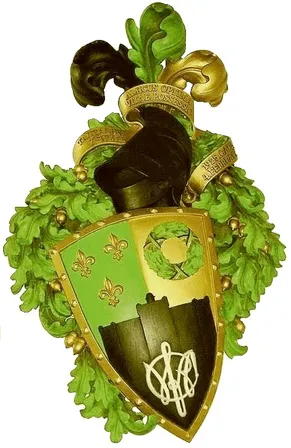
Around 1926 the convent made a model of its coat of arms in plaster. This pattern was changed over time, and on 4 February 1930 the coat of arms made by Hugo Mercs, 1925.II, was consecrated.
Members of the convent have taken an active part in all the institutions of the Presidium Convent. The convent has sent its representatives both to the Student Council and to the leadership of the F!B!S!. Until the Second World War the convent had standing basketball, athletics and volleyball teams, which took part in the various competitions held by the sports organisation of the Presidium Convent (P!K!S!). The convent presided over P!K! in the 2nd semester of 1930, the 2nd semester of 1938, the 2nd semester of 1995 and the 1st semester of 2006.
On 23 November 1934 the convent concluded a Treaty of Friendship with the student fraternity Tervetia. On 5 November 1938 a Treaty of Friendship was concluded with the student fraternity Šarūnas of Vytautas Magnus University in Kaunas, Lithuania.
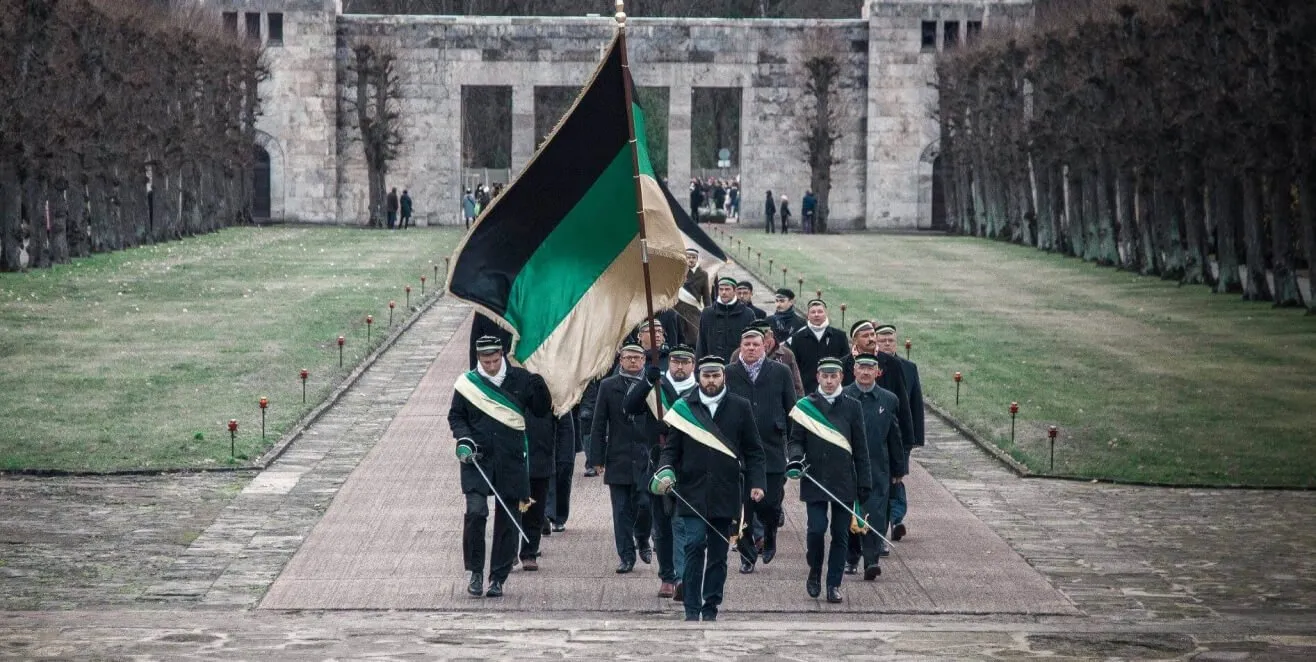
The fraternity was closed by a decision of the Minister of Public Affairs of 13 July 1940. By the time the active work of the convent was interrupted, 264 students and graduates of the University of Latvia and of the universities of tsarist Russia had sworn the oath to the black, green and gold colours.
During the German occupation the work of the fraternity was partly restored, and even one fox was admitted, stud. iur. Alfrēds Nerbulis, 1941.II, but many members had already scattered, some never to return; the laws of war prevailed.
After the Second World War the members of Academica first came together in larger numbers at a commers in Esslingen, Germany, in June 1947, when a presidium was elected. In exile, in the early 1950s, the philister Alfrēds Gulbis, 1933.II, began to trace the members. The first senior in exile, in the 2nd semester of 1951, was the philister Osvalds Uršteins, 1927.II. On 19 June 1965, at the ceremony marking 40 years since the convent’s founding, a newly made coat of arms by the philister Hugo Mercs, 1925.II, was consecrated by the founding philister Kārlis Būmanis. The fraternity presided over the Association of Latvian Fraternities (L!K!A!) in the academic years 1970/71 and 1988/89.
In honour of the members who fell in the Second World War, were repressed in Soviet times or have passed away, a memorial plaque designed by the artist and philister Gunārs Straumēns, 1964.I, was unveiled and consecrated on 18 August 1985 at the Latvian Brothers’ Cemetery laid out in the Catskill Mountains in the state of New York, USA.
In Latvia the work of the fraternity was restored on 4 February 1990 at an extraordinary special convent. On 28 March 1990 the fraternity’s statutes were approved at the University of Latvia. On 17 June 1991 the statutes of its Philisters’ Society were adopted. From the 2nd semester of 1990 to the 2nd semester of 1995 the fraternity had a presidium in Latvia and a global presidium abroad at the same time. Since the 1st semester of 1996 the fraternity’s global presidium has been in Riga. On 6 January 1994 the Philisters’ Society of the student fraternity Fraternitas Academica was registered as a public organisation at the Ministry of Justice of the Republic of Latvia. The student fraternity Fraternitas Academica was registered there as a public organisation on 18 March 1996. In January 2001, ahead of the fraternity’s 76th anniversary, the first song book of Fraternitas Academica was published.
Following changes in the legislation of the Republic of Latvia, the fraternity was entered in the Register of Associations and Foundations of the Register of Enterprises on 8 August 2005, and the F!B! on 20 October 2005.
On 7 November 2007 the Philisters’ Society of Fraternitas Academica was admitted to the restored Union of Philisters’ Societies (F!B!S!).
At the end of 2004 the philister Arnolds G. Rautenšilds, 1925.II, published a book about the fraternity’s members who had studied theology, 43 no korporācijas Fraternitas Academica (43 from the Fraternity Fraternitas Academica). In February 2005, marking 80 years since the founding, the first biographical encyclopaedia in the fraternity’s history was published, Album Fratrum Academicorum. In 2009 the fraternity’s website was opened, www.academica.lv.
Over the years the fraternity’s quarters have been at Ādmiņu iela 9 (in the second half of the 1920s), Zigfrīda A. Meierovica bulvāris 9a–1 (1931–35), Zigfrīda A. Meierovica bulvāris 16–1 (1936–40), Basteja bulvāris 4–1 (1992–93), Alberta iela 9–10 (1994) and Baznīcas iela 45–37 (since 1995).
In admitting new members the convent has never been guided by a narrow regional outlook; its members have represented different universities and faculties. From the founding of the fraternity in 1925 to the present day, 455 members have been admitted in all.
In the 2nd semester of 2010 Fraternitas Academica had 62 members in Latvia and abroad: new members, commilitones, philisters and guarantors of the comment.
The fraternity’s philisters who live abroad are united in the foreign branch of the Philisters’ Society.
Every semester the fraternity elects 3 representatives of its presidium to work in the Association of Latvian Fraternities (L!K!A!).