
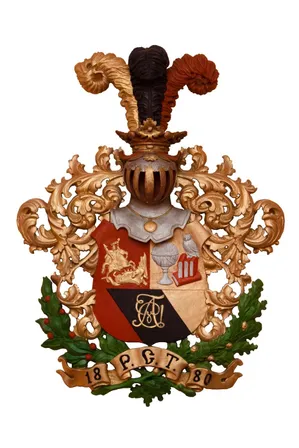



On 21 October 1880 in Riga, 15 colour-bearers and 11 Fechtbodisten of the recently closed student fraternity Borysthenia, most of them students of Russian nationality, together with other students of the Riga Polytechnic, decided to found a new student fraternity, this time a Russian one: Fraternitas Arctica, with the colours gold, grey and red.
As a student fraternity in Germany already had these colours, Fraternitas Arctica changed its colours to gold, black and red, and for the cap to black, gold and red, and took as its motto a saying in Old Church Slavonic, Р.С.Т. – Рцы Слово Твёрдо, Rci Slovo Tverdo (Keep the word you have given). The fraternity was admitted to the Riga Chargierten-Convent (C!C!) on 6 November 1880, but the convent of Fraternitas Arctica received the notice of admission from the senior of the C!C! only on 7 November, and the fraternity regards that as the day of its founding. After its admission the convent settled the question of the embroidery on the cap and decided that in the middle of the crown there would be the fraternity’s Zirkel embroidered in gold, with an exclamation mark made up of eleven gold dots, which stand for the month of founding (November). Around the Zirkel seven loops are embroidered, joined in one unbroken line, standing for the day of founding (the 7th). These officers were elected to the first presidium: senior, Dāvids Rihters; vice-senior, Viktors Brokmillers; secretary, Ivans Jeveckis; Oldermann, Karls Kohs.
The new fraternity, whose rolls included members of other nationalities besides Russians, took the side of the first Latvian fraternity members, who were fighting for the right to wear their colours openly. In 1897 Fraternitas Arctica, together with the Polish fraternities Arkonia and Welecja, voted for the recognition of the Latvian fraternity Selonija and its admission to the Riga C!C!. In 1915, as the German army approached, the Riga Polytechnic Institute (formerly the Riga Polytechnic) was moved to Moscow. Fraternitas Arctica moved there too and was officially active in Moscow until the end of the 1st semester of 1916. In this period its internal life was inactive, as many members had been called up. At the start of the Russian Revolution the fraternity suspended its activity. During the war and the revolution Fraternitas Arctica lost many commilitones and philisters. When the Philisters’ Society of Fraternitas Arctica was founded in Riga on 11 January 1922, it turned out that the number of the fraternity’s members had fallen from 455 to 55.
On 8 February 1922 the fraternity, consisting of 3 colour-bearers and one Fechtbodist, resumed its work at the University of Latvia, and on 31 October of the same year Fraternitas Arctica was admitted to the Presidium Convent (P!K!). In the autumn semester of 1922 the fraternity admitted 26 foxes. In May 1940 it had 180 members. In its external life Fraternitas Arctica concluded cartel agreements with the following student fraternities: Neo-Ruthenia (St Petersburg); Vironia and Fraternitas Aeterna (Tartu and Tallinn); Fraternitas Slavia, Fraternitas Ruthenia, Fraternitas Ergonia and Boeteia (Tartu and Tallinn); and Fraternitas Slavia (Prague).
Fraternitas Arctica is the only Russian student fraternity in existence today. Although it is a Russian fraternity, its rolls also include Latvians, Germans and Poles (and members of other nationalities) who feel close to Russian culture and the Russian language. Fraternitas Arctica has always been apolitical. Its aim was and is to bring up its members in the spirit of friendship among fraternity members, love of the fatherland, academic traditions and mutual respect. Fraternitas Arctica presided over the Presidium Convent in the 2nd semester of 1924 and the 1st semester of 1933. In 1940 the Soviet authorities, occupying Latvia, put an end to the fraternity’s work. It was restored in Germany after the Second World War. When the emigration of Latvia’s people to countries overseas grew in the 1950s, the global convent of Fraternitas Arctica was moved to the USA, with a chapter of the fraternity in Germany. Since 1 January 1988 the global seat of Fraternitas Arctica has been in Canada. Since 19 May 1990 Fraternitas Arctica has again been officially active in Latvia. In the 2nd semester of 2011 Fraternitas Arctica again presided over P!K!.
In the course of its existence about 800 students have been admitted to the convent of Fraternitas Arctica, and more than 400 of them have become philisters. Outside Latvia, Fraternitas Arctica is active at the University of Tartu, where 6 students have already been admitted.