
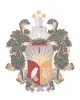

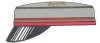

The aim of Fraternitas Vesthardiana is to bring up and cultivate in its members a spirit of loyalty to nation and state, a sense of honour, manliness and an awareness of duty, and to give them moral and material support. The name of the fraternity is linked with that of Viesturs (Vesthardus), the chieftain of Zemgale. The meaning of the colours: grey for a will of steel, red for love of the homeland, gold as the pledge of the fatherland’s golden freedom. Fraternitas Vesthardiana vouched for the A!K!K! with Selonija. It was admitted to the Presidium Convent on 27 April 1926. In 1928 the Philisters’ Aid Society was founded, which was admitted to the Union of Philisters’ Societies in 1930.
On 8 October 1928 the Philisters’ Aid Society presented the convent with a coat of arms made by the artist Arturs Bērnieks. The flag was given by the convent’s Ladies’ Committee. Fraternitas Vesthardiana presided over P!K! in the spring semesters of 1930 and 1938. The last convent quarters in Riga were at Elizabetes iela 33a, where the convent remained until the communist occupation and its closure.
In 1941, 6 members of the convent were deported. When the Germans came in, the convent partly resumed its work and elected officers. The German occupation authorities called many members of Vesthardiana up into the army, where, doing their duty, several gave their lives for the homeland, and many are missing to this day. On 11 October 1953 the convent resumed its work in exile. Of the whole family of Fraternitas Vesthardiana, 63 have been traced in the free world; scattered over every continent, they make up only 27% of the whole family. On 19 July 1954 a comment for exile was adopted. On 19 May 1956 the convent’s Ladies’ Committee presented the convent with a restored flag. On 8 April 1959 the restored Internal Comment was adopted. A Self-Help Fund was founded and is at work. A periodical, Fraternitas Vesthardianas Vēstnesis, is published. The convent of Fraternitas Vesthardiana sees as its main task in exile to unite all the members living in the free world and to bring up the new members of the convent in a fraternal and national spirit.