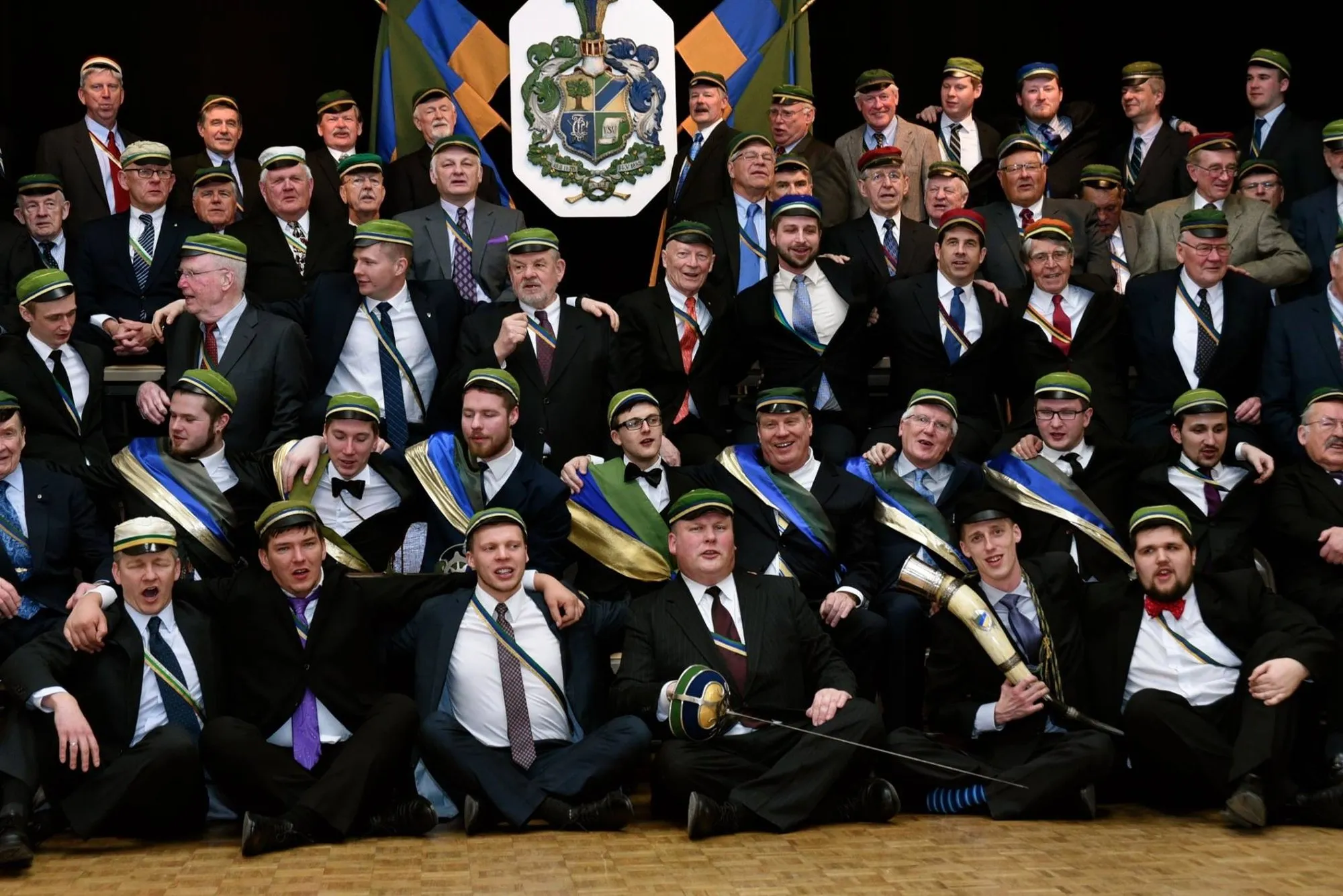
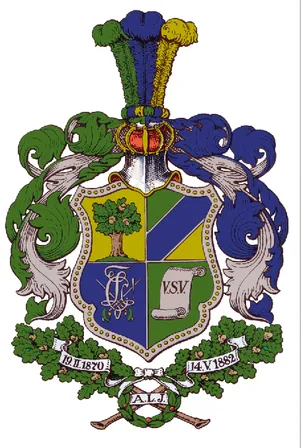
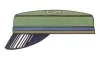

On 19 February 1870 a group of Latvian students of the University of Tartu, led by Atis Kronvalds, founded the Latvian Literary Evenings of Tartu, which on 3 December 1881 took the name Fraternitas Lettonica and on 20 February 1882 the name Lettonia. Its first colours, adopted as early as 1870, were red, white and red. A year later they were changed to red, white and gold, and on 11 March 1882 to green, blue and gold. On 10 May 1882 the Chargierten-Convent of Tartu legalised the fraternity, and on 14 May the members of Lettonia appeared in public in their colours for the first time. Lettonia vouched for its comment with the fraternity Curonia.
For the study of Latvian culture there has been a Literary Evening since 1870, which still works as an autonomous part of Lettonia with its own officers and statutes. In its Tartu period Lettonia did great work for the development of the Latvian language and culture. As early as 1870 it founded a library and staged the first theatre performance in Latvian in Tartu. In the next few decades it published J. Alunāns’s collection of writings “Sēta, Daba, Pasaule”, the series of encyclopaedic writings “Latvju tauta” and the first collection of student songs in Latvian.
In 1907 Lettonia concluded a cartel agreement with Selonija, in 1908 with the Estonian fraternity Fraternitas Estica and in 1909 with Talavija. In 1912 the first Album Lettonorum appeared. Lettonia’s Tartu period ended with the First World War and the fight for freedom. In Latvia’s War of Independence 132 members of Lettonia took part, volunteering for the Separate Student Company founded in 1918 and fighting in other units of the army.
After the Latvian state was established, Lettonia moved to Riga and began its work at the University of Latvia, taking part in the founding of the Presidium Convent. In 1921 the fraternity’s philisters acquired a house in Riga, at Valdemāra iela 55. In the 1920s Lettonia grew fast (more than 100 were admitted in the first three coetus). Its external life was active too.
Beveronija, Philyronia, Fraternitas Academica, Fraternitas Lataviensis and Fraternitas Livonica vouched for the comment with Lettonia. Lettonia encouraged the founding of the first sorority, Daugaviete, and took part in founding the P!K! Men’s Choir. In 1930 it published a new Album Lettonorum and in 1932 a supplement to it. In 1937 a treaty of friendship was concluded with the Lithuanian student fraternity Neo-Lithuania. Since 1882 the philisters of Lettonia have been organised in the Philisters’ Society of Lettonia, which took part in organising the Union of Philisters’ Societies and gave it its first head in 1928. The Ladies’ Committee of Lettonia has been at work since the days of Tartu.
In the summer of 1940, when the Soviet Union occupied Latvia, Lettonia was closed and its property confiscated. By July 1941 the communist repressions had struck more than 70 members of Lettonia. During the Second World War the work of the convent was not officially restored, but the members of Lettonia gathered at 3 commerses and other meetings. In 1943 the authorities agreed to legalise the Philisters’ Society of Lettonia. During the Second World War more than 110 members of Lettonia took part in the armed fight against communism in the Latvian Legion and other units, and in the ranks of the Latvian resistance movement.
In the last phase of the war a great number of the members of Lettonia went into exile, and most of them reached Germany. A united life of the convent was restored on 19 February 1947 in Esslingen. A year later, in the same place, decisions were taken on the global structure of the organisation, on including the philisters in the active convent and on admitting new members to the General Convent. In 1948 Fraternitas Cursica, the fraternity founded at the Baltic University in Pinneberg, vouched for the comment with Lettonia.
Because most of the members of Lettonia emigrated to the USA, the seat of the convent of Lettonia was moved to New York in 1950. The active life of Lettonia in exile went on in 22 chapters: 3 in Australia, 3 in Europe, 2 in Canada and 14 in the USA, uniting about 500 members. Since 1953 an internal journal, Vita Nostra, has appeared. In honour of Atis Kronvalds, the founder of the Latvian Literary Evenings of Tartu, the Kronvalds Fund was created in 1977; its main aim is to further the upbringing of the members of Lettonia and their work in a national spirit.
In occupied Latvia the members of Lettonia first uncovered their colours on 11 November 1988 at Airītes, together with philisters of Talavija, Selonija and Lettgallia. The work of Lettonia in Latvia was restored by 32 philisters in the summer of 1989. In October of that year the first new coetus was admitted, which included many sons and relatives of members of Lettonia. From 1992 the Internal Comment was fully in force again and only students were admitted. Commilitones admitted after the restoration began to take on the role of officers. Lettonia’s first regular meeting place was the premises of the men’s choir “Tēvzeme” in Jauniela, in Old Riga, and after that rented rooms in Torņa iela. From 1991 work began on taking the old quarters at Valdemāra iela 55 back into use, until in 2003 Lettonia moved into the new Convent House at Rūpniecības iela 4a, built with the proceeds from the sale of Valdemāra iela 55 and other real estate of the Philisters’ Aid Society of Lettonia, as well as with substantial private donations. In the course of the 1990s the traditions of Lettonia and its active everyday life were fully revived. Riga again became the heart and the centre of attraction of the whole family of Lettonia. The work of Lettonia’s chapters outside Latvia has narrowed, but their role is still important. The new Convent House serves as the best symbol of the fellowship and unity of Lettonia.
Lettonia today is among the largest and most respected Latvian fraternities, and it is its duty to carry this good name into the future, faithfully serving the aims it proclaimed in 1870.