
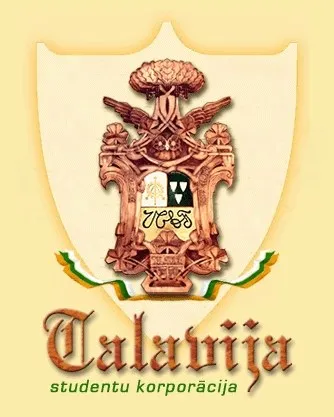
On 14 December 1900 the students of the Riga Polytechnic Institute were invited to gather at the Riga Latvian Society to decide on a new Latvian student organisation. The large meeting was chaired by Vilis Olavs, a philister of Lettonia, and when, after the debate, he said that the only question could be that of founding a new fraternity in Riga, only 25 students stayed in the hall; they signed the minutes of the founding of Talavija. Its principles were laid down as nationality, education and temperance, and it adopted the mottos “Roku rokā” (Hand in hand) and “Darbs ceļ vīru” (Work makes the man).
Eighty-nine years have now passed since that day, and in the book of the members of Talavija the first entry, Vilis Olavs, is followed by close to 1,500 other names. All of them have tried to serve the principles and mottos of Talavija, and many succeeded until the moment a small cross was set against their name. Those with an asterisk tried, but could not.
The beginning was particularly hard, and by 7 May 1907, when Talavija was admitted to the Riga C!C!, it had only 106 members in all. The C!C! also ruled that the colours Talavija had chosen, white, blue and gold, must be changed to white, green and gold. The crisis came in 1915, when because of the war the Riga Polytechnic Institute was moved to Moscow. Only a few could continue their studies, and many were mobilised. At Talavija’s 15th anniversary in Moscow only 56 of its 244 members took part.
For the Latvians, and with them for the members of Talavija, the year written in the stars is 1918. In the fateful November of that year the flag of Talavija was in Riga again, and the 2nd coetus of 1918 had 38 new members. On being asked, and led by their Oldermann, they kept order at the ceremony proclaiming the independence of Latvia, and in December the General Meeting of Talavija resolved that all must join the army of independent Latvia. Selonija resolved the same, and with that, on 20 December, the Latvian Minister of Defence founded the Separate Student Company. Forty-seven members of Selonija and 43 of Talavija joined it, as did members of Lettonia, Lettgallia and Fraternitas Lettica. Their convents had not yet resumed their work in Riga at that time.
The next decisive event in the life of the Latvian fraternities was the founding of the Presidium Convent in September 1919. Lettonia, Selonija, Lettgallia, Talavija and Fraternitas Lettica agreed on it. P!K! began to work fully, however, only a year later, after Bermondt’s attack. A philister of Talavija, Visvaldis Dūms, was chosen as the first senior of P!K!.
Whatever differences there had been between the convents before Latvia was founded, P!K! drew a line under them. The foundations of the true fraternity spirit were laid at Skrunda, Airītes, Slampe and Kalnciems, and not by the clauses of a treaty but by brotherhood in arms and by blood. In this spirit the other convents worked too, those that joined P!K! later and the new ones founded in independent Latvia. Together, in twenty years of selfless work, they built a Latvia on which the sun would not have set, had 1940 not come, when the communists destroyed everything.
In this period Talavija admitted 592 members, and in December 1939 there were 162 in the active convent and 301 in the Philisters’ Society. In the work of building Latvia no one spared himself, least of all the philisters. Three were prime ministers, and there was no significant civic party in which members of Talavija did not take part. When the communists came in, the retribution was unbelievably heavy. Several members of Talavija were arrested at once and killed in the prisons. Seventy-seven were deported together with their families. Only five returned years later, to die in the homeland. In exile Talavija has existed longer than in Latvia. The total is at present 436, but they are scattered in 25 chapters on five continents. The winds of the world are strong and various. Nationality is the gold colour in the flag of Talavija. The hearts of all its members still belong to it. Talavija resumed its work in Latvia on 23 May 1989.