P!K!

From Europe’s universities to Latvia

A history of student fraternities

How did students’ wish to stand together become a tradition of lifelong friendship? The journey leads through medieval universities, regional societies and academic life in the Baltic.

Start reading

12th century — present

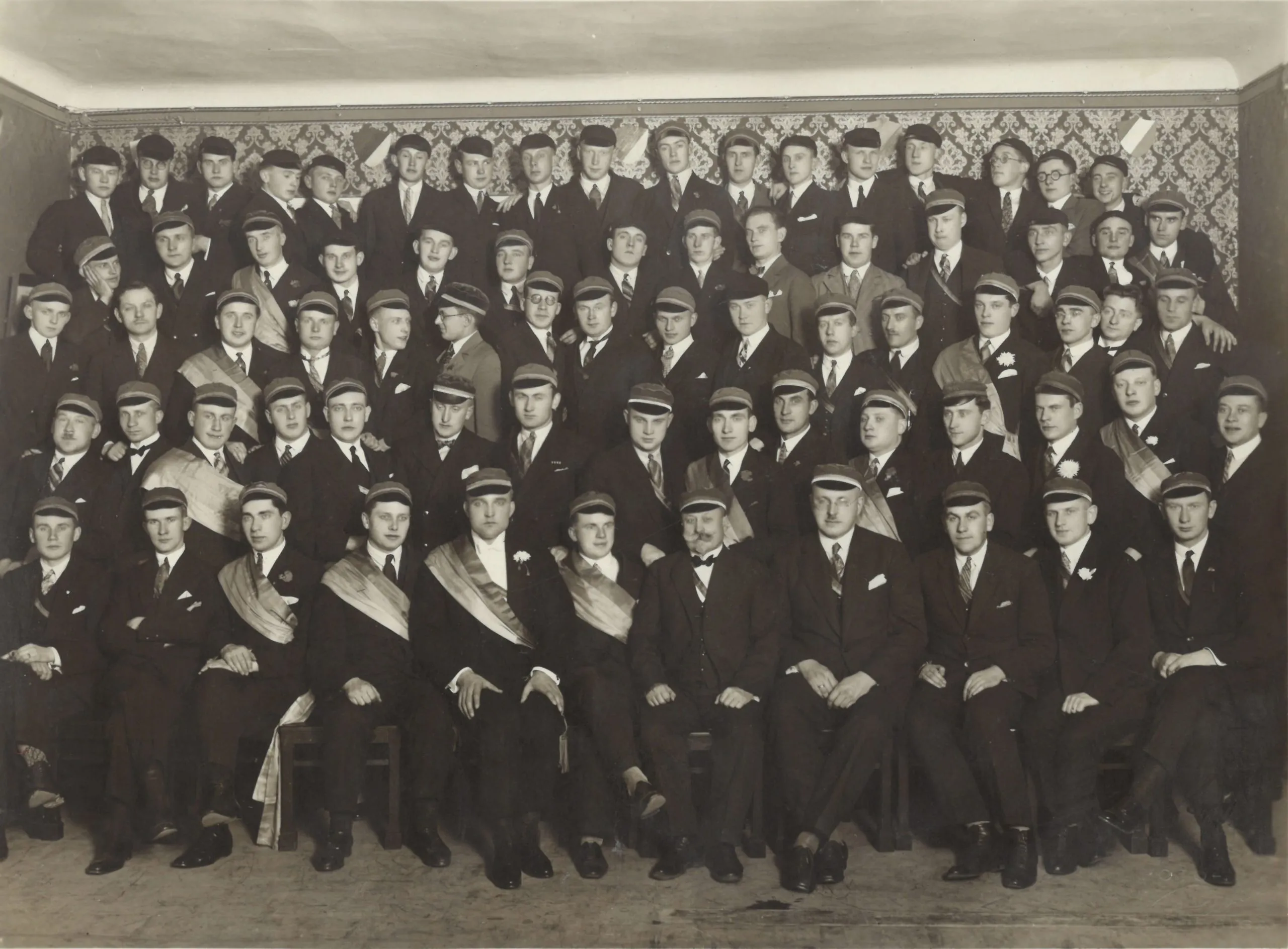
Historical group photograph of Beveronija members wearing caps and colour sashes.
Members of Beveronija. Historical photograph.

Moments in history

1158

Standing together abroad

Academic freedom and associations of students from the same region lay the foundations for centuries of fellowship.

Read this chapter

16th–18th c.

From shared lodgings to fellowship

Regional societies, orders and student circles shape customs, symbols and the idea of lifelong friendship.

Read this chapter

1802

The tradition takes root in the Baltic

The reopening of the University of Tartu becomes a bridge between German student life and the Baltic.

Read this chapter

1815

Belonging for life

The German Corps bring earlier traditions together. Friendship and membership extend beyond the years of study.

Read this chapter

1870

The Latvian fraternity story begins

Lettonia, the first Latvian student fraternity, is founded in Tartu. Convents follow in Riga and other university cities.

Read this chapter
Chapter 011158

Standing together abroad

Academic freedom and associations of students from the same region lay the foundations for centuries of fellowship.

Medieval universities drew students from many lands. In an unfamiliar city, a shared place of origin helped them find allies, defend their interests, care for friends and feel that they belonged.

The privilege Authentica habita, proclaimed in 1158, is one of the historical foundations of academic freedom. Student associations called nationes brought together students from the same region or country.

In Bologna, the students’ own general assembly — conventus publicus — played an important role. Elected representatives received greater rights and carried greater responsibility. In Paris, university and clerical authorities exercised more control over student life.

Chapter 0216th–18th c.

From shared lodgings to fellowship

Regional societies, orders and student circles shape customs, symbols and the idea of lifelong friendship.

Shared lodgings at German universities, and later independent student societies, developed their own rules of social life. Regional societies, or Landsmannschaften, helped members, cared for the sick and cultivated friendship.

Ranks of membership modelled on craft guilds also entered these societies. Echoes of this history remain in fraternity vocabulary and traditions today.

At the end of the 18th century, smaller student circles, or Kränzchen, placed particular emphasis on personal development, honour and discipline. They adopted the ideals of fellowship and lifelong friendship from the orders; the origins of the zirkel can also be traced to this setting.

Chapter 031802

The tradition takes root in the Baltic

The reopening of the University of Tartu becomes a bridge between German student life and the Baltic.

When the University of Tartu reopened in 1802, Baltic students returned from German universities, bringing familiar forms of academic social life with them.

Curonia was founded in Tartu in 1808, initially admitting students from Courland. Other fraternities followed, and in 1832 the Baltic German fraternities formed the Chargierten-Convent of Tartu.

In Riga, fraternity life developed around the Polytechnic. Fraternitas Baltica was founded in 1865, followed by the Riga Chargierten-Convent in 1871. The unions of the two cities concluded a cartel — an agreement of recognition and friendship — in 1873.

1808

Curonia is founded in Tartu, an early bearer of the Baltic fraternity tradition.

Chapter 041815

Belonging for life

The German Corps bring earlier traditions together. Friendship and membership extend beyond the years of study.

In early 19th-century Germany, the Corps developed as student societies whose organisation and ideals became important to modern fraternities. They brought together academic customs, the wearing of colours, a sense of honour and fellowship.

The senior became an elected leader and representative. Membership no longer necessarily depended on coming from the same region.

By the middle of the 19th century, the Lebenscorps principle had taken hold: a person belonged to one fraternity for life. Friendships begun during university became a bond between generations.

Chapter 051870

The Latvian fraternity story begins

Lettonia, the first Latvian student fraternity, is founded in Tartu. Convents follow in Riga and other university cities.

In 1870, Lettonia was founded in Tartu as the first Latvian student fraternity. Selonija followed in Riga in 1880, then Lettgallia in Tartu and Talavija in Riga around the turn of the century.

Baltic academic life was multilingual. Alongside Latvian and German fraternities were Polish, Russian and Jewish fraternities; the idea also spread to other university cities.

After Latvia became a state, five Latvian fraternities began working together in Riga on 27 September 1919. Their cooperation grew into the Presidium Convent — the next chapter in this history.

Words with a history

Open a term to discover more.

Nationes

Associations at medieval universities whose members came from the same region or country. They helped students defend their interests while living abroad.

Cirķelis

A fraternity’s identifying monogram, combining letters and lines. Its origins are connected with the symbols of student orders and circles.

Filistrs

A fraternity member who has completed his studies. Lifelong membership maintains the connection with the convent after graduation.

Curious to go deeper?

The complete historical text, with events, people and details.

Read the full history

Students have organised themselves in societies for as long as there has been academic life. Over the centuries, following its ideals and the spirit of the times, this form of fellowship has developed down to our own day. That is why today’s fraternities are the only student organisations whose development rests on academic traditions, ideals and spirit.

The beginnings of the fraternities are to be found in the 11th and 12th centuries, when students gained what is called academic freedom. It was founded on the privilege “Authentica habita”, proclaimed in 1158, which granted students various privileges. A student, for example, was not subject to the civil courts and was allowed to carry a weapon. At that time a considerable number of foreign students were studying at the universities of Italy (Bologna, Padua, Perugia), France (Paris, Orléans) and Spain (Toledo). The privileges they had gained led to the rise of the “nationes”, closed societies of students of different nationalities. The nationes allowed students abroad to follow the natural urge to hold together and associate, so as to defend their interests, their honour, their friends and their nationality. The nationes had a marked regional or provincial character, since their members came from one region. From this time the fraternities have kept terms from Latin and French, for example tautietis (compatriot), which is used for a member who wears the colours.

In the Middle Ages two forms of student organisation took shape, that of Bologna and that of Paris. In Bologna the students themselves ran their internal life. In the nationes sovereignty belonged to the general assembly, the “conventus publicus”, and democratic principles were observed in it. All members had equal rights, but the assembly gave its elected representatives greater rights and demanded greater responsibility of them.

In Paris, where the clergy had great influence, order was laid down not by the students but by the chancellor. New members (beani) were brought up in a strictly fixed order that had been taken over from Bologna. The University of Paris also practised the custom of pennalism, which meant giving privileges to the older students. The younger had to do everything the older ones ordered and to bear unfounded insults until he reached full standing, the absolution. This tradition, in a far milder form, can be seen in today’s fox period. Certain remnants of pennalism, although officially opposed, were also met with in Latvia, when attempts were made to give “godsons” tasks of a purely personal kind that had nothing to do with the life of the convent.

In the 14th century the first German universities were founded, in Heidelberg, Vienna and Prague. At these universities students associated on the model of the Paris organisations, in nationes (Landsmannschaften). The social life of students took place in compulsory hostels (the bursa), where strict discipline prevailed. This period gave us the word “buršs”, which does not come from the German word “Bursche” and means a youth, a journeyman. In general there are several, and opposing, views on the origin of the word “buršs”, its meaning and whether it is fitting to call fraternity members by it. In the language of Latvian fraternity members, however, “buršs” has taken such deep root and gained so positive a ring that replacing it with another word is unthinkable.

In the years that followed, student traditions at the German universities went on developing and grew more varied, taking over some traditions from the craft and merchant guilds. Nationes of other nationalities were also active at the German universities, in Prague for example those of the Poles, Bavarians, Saxons and others. Quarrels between students of different nationalities were often settled with the sword, which was part of a student’s dress at the time. There were also fights between students and craftsmen or knights. The period also knew the wandering student (the vagrant), who earned his living by giving lessons.

Ranks of membership began to appear in the student societies, modelled on the craft guilds: fox (boy), Bursch (tautietis) and philister. The tradition of admitting the “bean”, the deposition, was also revived. It took the form of an initiation ceremony, which was a rough one. This tradition lasted until the 18th century.

After the Reformation, in the 16th century, the bursae were replaced by the “Collegium”, later the “collegia nationalia”. These were student societies that worked on the model of the guilds and were independent of the university. In time they took on the character of regional societies. Such a society was also active at the first university in the Baltic, founded in Tartu (Tērbata) by Gustavus Adolphus in 1632. The saying “free as a Bursch” is attributed to this period. This way of life continued until the second half of the 18th century, when, under the influence of the Masonic movement, the first secret orders made their way into the regional societies. The lust for power and the free-thinking views that reigned in the secret orders pushed the traditional structure out of the regional societies. Because students were rather unruly, provoked disturbances and came into conflict with the authorities, the activity of the regional societies was from time to time restricted or suspended. The guilty were punished and forbidden to wear their badges and swords.

The beginning of the beer comment is to be found at the start of the 17th century (1616); in 1717 Gaudeamus was sung; in 1781 the first commers song book was compiled.

The aims of the regional societies (Landsmannschaften) were mutual help, friendship, caring for sick friends, burying the dead and showing respect to the authorities of their province. By origin the members had to come from one region. In the regional societies power was concentrated in the hands of the officers: the senior, the consenior and the secretary. In the course of time the regional societies began to pay ever more attention to questions of social life and upbringing.

At the end of the 18th century the regional societies, which at times were forced to work in secret, began to organise themselves in smaller groups, whose cores were circles (Kränzchen). These set themselves against the orders but took over from them the principles of brotherhood, lifelong friendship and silence. The origin of the Zirkel, the monogram, is also to be found in the organisation of the orders. The circles drew up a comment of honour and strict rules of social life. At the end of the 18th century the regional societies worked according to the old Jena comment, knew the Landesvater ceremony and had drawn up a fencing comment. Challenges had been issued ever since the 16th century, when the obligation to give satisfaction was introduced and Mensur bouts were fought. The word “pennal” was replaced by the word “fox”, which comes from the Latin word “feux” (leaven, sediment). The German “Fuchs” used today is a vulgarisation of the Latin word. In the circles attention began to be paid to cultivating the student’s personality, to lifelong friendship, the sense of honour, chivalry and discipline. In the 18th century, however, neither the regional societies nor the orders nor the circles satisfied the social needs of all students. A new form of student organisation appeared, the Corps. The structure of the new organisation, and the views and ideas of the time, found their answer in the forms of the old academic traditions. It is the Corps, which began to work around 1815, and not the German Korporationen (societies), that are the origin of our fraternities.

The beginnings of the Corps are to be found in the regional societies and the circles, more rarely in the orders. In this period there took shape the idea of lifelong friendship, the rule that a student may not be a member of another society, and the rule that belonging to one particular region is not to be required. The fraternities formed as closed societies with few members (10 to 30). Their principles and way of life resembled those of today’s fraternities. The senior was no longer the one who laid down the order of life in the Corps, but the democratically elected leader and representative of his society. In 1812 the Jena comment was drawn up, which is the basis of the comments of today’s fraternities. The word “komāns” (comment) comes from the French word “comment” and the Latin “commentarius” and means notes, explanation, norms, customs.

The further development of the fraternities was interrupted by the Napoleonic wars and the occupation of Germany. When peace returned, the so-called Burschenschaften began to be founded, which hoped to unite all students in themselves. They did not require regional origin, and their activity rested on political considerations (the unification of Germany). The mottos of these organisations were honour, freedom, fatherland. The Burschenschaften brought about the abolition of the regional societies in Jena, and their activity greatly weakened the foundations of the academic traditions. Soon, however, disagreements arose between the leaders of the separate units, which caused a certain disorder. Because of it the government closed the Burschenschaften. The government also began to look with suspicion on the other student organisations and often suspended their activity or forbade them to wear their distinguishing marks. The Corps came through this period most successfully. Learning from the mistakes of the past, the Corps created an organisation which took over from the regional societies the academic customs and the wearing of colours; from the orders the idea of lifelong friendship and brotherhood, the principle of selecting members and some ceremonies; from the circles the understanding of honour and the forming of the personality; and from the Burschenschaften patriotism, Christianity and the procedure for settling matters of honour, which, it is true, existed in all the forms of organisation listed. Around this time, to coordinate their work, a seniors’ convent was organised and cartels were concluded with the fraternities of other universities.

In the early period most of the members of a Corps came from one region, and they could belong to several Corps if they changed university, keeping the colours of their previous Corps. This variety of Corps was called the “Waffencorps”. In the middle of the 19th century the Corps adopted the structure of the so-called “Lebenscorps”, in which a member belonged for life to one society only. At this time the present institution of the guarantor of the comment arose, for the so-called general convent was founded, in which the foxes, the colour-bearers and the Renoncen took part, the last being guarantors of the comment in today’s sense.

In 1815 the fraternities in Heidelberg revised the beer comment and the customs of social life. In 1840 the fencing comment was made more precise.

In the 19th century certain groups of students with radical views arose and began to fight the fraternities and their principles. The fraternities answered these attacks by founding umbrella organisations of fraternities at the universities, the seniors’ convents, which united and coordinated their work.

At the end of the 19th century the Burschenschaften and the regional societies resumed their activity. Groups of gymnasts (Verband der Turnerschaften) and of choirs (Deutsche Sängerschaft) were also active. These organisations and the seniors’ convents of four fraternities formed the so-called duelling colour-bearing associations (schlagende Verbände). Many anti-duelling associations were also active in Germany, such as the Catholic student organisation Unitas, where colours were worn but the Mensur was not accepted. From Germany the fraternity movement spread to the neighbouring countries: Austria, Switzerland, western Ukraine and elsewhere. In Germany the fraternities existed until 1935, when the state closed them. After the Second World War the fraternities in Germany resumed their activity.

When the University of Tartu reopened in 1802, Baltic students who had been studying in Germany continued their studies in Tartu. With them they brought the ways of student life in Germany and gave them life there. This was made easier by the fact that the University of Tartu was shaped on the model of the German universities. In 1808 the first Landsmannschaft, Curonia, was founded in Tartu; it had earlier been active in Jena and Göttingen and admitted only Courlanders. Later other societies were founded in Tartu, which began to call themselves fraternities (korporācijas). The Baltic German fraternities founded in Tartu united in 1832 in the Chargierten-Convent (Ch! C!).

In 1861 the first technical university in the Baltic was founded, the Riga Polytechnic. The first Baltic fraternity there, Fraternitas Baltica, was founded in 1865, followed by others, which in 1871 united in the Riga Chargierten-Convent (C! C!), active until 1918.

At first the Ch! C! of Tartu did not wish to recognise the C! C!, but in 1873 a cartel was concluded between the two convents. Every newly founded fraternity, in Tartu and in Riga alike, needed the recognition of the Ch! C! or the C! C! before it was confirmed by the leadership of the university; this recognition gave the fraternity the right to appear officially in public and to wear its colours.

Besides the German and Latvian fraternities, Polish, Russian and Jewish fraternities were also founded in the Baltic. The idea of the fraternity reached Russia too, where fraternities were founded at the universities of Moscow, St Petersburg and Odessa.

The first Latvian fraternity, Lettonia, was founded in Tartu in 1870. The first Estonian fraternity, Vironia, was founded in Riga in 1900. In Lithuania the fraternities followed the structure of the Catholic organisations in Germany. They wore colours, but giving and taking satisfaction was not part of their way of life.